
Hot air brushes are moving from being individual styling products to becoming part of well-planned retail product lines based on multi-functionality, channel suitability, differentiation through private labels, and readiness for compliance.
In 2026 wholesale planning, procurement specialists should consider not only the look and unit cost but such factors as the airflow, attachments, temperature options, voltage, plug type, packaging, documents, quality control, after-sales conditions, and merchandising support. The existing assortments range from regular hot air brushes to high-speed brushes, swappable head brushes, and styling systems consisting of six devices. Oucai is a professional manufacturer of personal hair care and men’s grooming products including high-speed hair dryers, hot air brushes, hair clippers, and electric shavers.

Why Custom Private Label Hot Air Brushes Matter in 2026
Private Label Is Becoming a Strategic Retail Asset
Private label is increasingly used to create differentiated assortments rather than simply offer the lowest price. Broader European retail data—not specific to hair appliances—showed private-label value share reaching 38.8% across 17 markets in 2025, with retail brands increasing share in 12 markets. This direction supports a procurement model centered on controlled specifications, distinctive presentation, dependable replenishment, and clear margin architecture.
For hot air brush programs, private labeling can connect product design, packaging language, attachment selection, and channel positioning under one retail concept. Meaningful differentiation also limits direct comparison with generic listings.
Multifunctionality Supports Assortment Efficiency
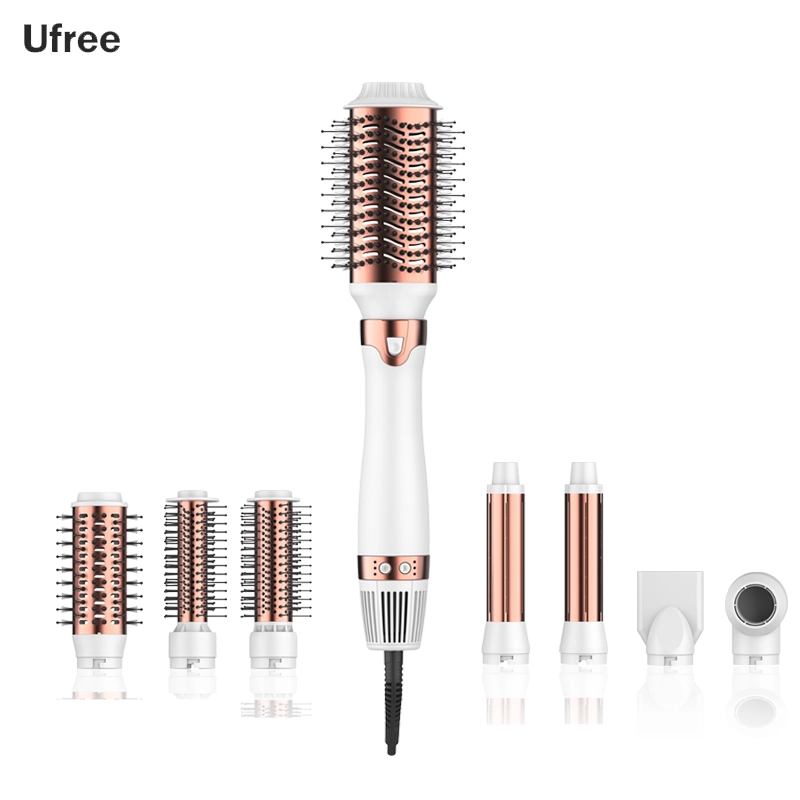
A multifunctional hot air brush can combine drying, smoothing, volumizing, shaping, or curling functions through one handle and several attachments. This can reduce the number of separate devices required in an assortment while creating a higher-value kit format.
Attachment count alone does not determine value. Every head should have a clear role and visible difference. Repetitive attachments may increase tooling, packaging, freight, and customer-service complexity without improving sell-through.
Product Architecture for Retail Success
Match the Format to the Sales Channel
Product architecture should follow channel strategy. Mass retail may prioritize intuitive controls, compact packaging, clear shelf communication, and a controlled price point. E-commerce can support broader attachment sets because videos and comparison images explain additional functions. Salon supply and distributor channels may emphasize durability, carton efficiency, replacement availability, and technical documentation.
The current catalog includes high-speed hot air brushes, head-change multifunctional wind combs, and 6-in-1 hair dryer brush formats. This range illustrates why procurement teams should build channel-specific assortments rather than apply one configuration to every market.
Lock Specifications Before Sampling
A sourcing brief should define rated voltage, frequency, wattage, heat and speed settings, noise target, cord length, plug type, materials, attachment interface, product dimensions, package dimensions, and master-carton configuration.
One current 6-in-1 listing specifies 110/220V, 50/60Hz, 800/1000W, three temperature levels, a two-meter cord, and 12 units per carton. Such details show why model-level confirmation matters. Catalog descriptions should not replace an approved specification sheet, signed sample, test plan, and purchase-order standard.
Private Label Customization Priorities
Build a Controlled Product and Packaging System
Private-label development begins with more than logo placement. Color standards, surface finish, control markings, attachment icons, rating labels, manuals, gift boxes, inner trays, barcodes, carton marks, and product photography should form one controlled system.
Packaging must protect the appliance, communicate functions quickly, fit shelf or parcel dimensions, and withstand distribution. Both retail presentation and transit performance require approval before mass production.
Separate Cosmetic and Engineering Changes
Logo printing, color selection, packaging artwork, and accessory combinations have a different risk profile from changes to heating systems, motors, airflow paths, electronic controls, or housings. Engineering changes may affect testing, tooling cost, lead time, reliability, and certification scope.
An RFQ should classify each request as cosmetic, packaging-related, component-related, or structural. This makes quotation comparisons more accurate and reduces late-stage disruption.
Compliance and Quality Assurance
Treat Documentation as Part of the Product
Procurement approval for electrical styling tools should include applicable safety, electromagnetic compatibility, restricted-substance, labeling, traceability, and waste-management requirements. In the European Union, the General Product Safety Regulation has applied since December 13, 2024, strengthening obligations around safety, technical documentation, responsible economic operators, product identification, and traceability. Relevant electrical equipment may also fall within RoHS and WEEE requirements.
Compliance must be assessed by exact model, market, voltage, plug, component set, and packaging claim. Procurement teams should review test reports, model references, technical files, declarations, label artwork, warnings, and local-language instructions.
Establish Quality Gates Before Production
A practical quality plan includes a pre-production sample, golden sample approval, component checks, in-process inspection, functional testing, appearance criteria, packaging checks, and final inspection. Official service information states that pre-production samples and final inspections are used as quality controls.
Purchase agreements should define defect classification, inspection method, rework responsibility, spare-part support, warranty handling, and corrective-action timelines. Warranty, repair, technical support, replacement, and return categories should be confirmed in writing for each order.
Commercial Planning for Wholesale Orders
Calculate Total Landed Cost
Commercial comparison should include product cost, custom packaging, tooling, samples, testing, inspection, inland transport, freight, insurance, duties, warehousing, warranty reserves, and expected defect handling. A lower quotation may become more expensive when cartons are inefficient, packaging fails, documentation is incomplete, or after-sales responsibilities are unclear.
Margin planning should include realistic promotion, return, and markdown exposure rather than relying only on a target retail price.
Use Pilot Orders and SKU Discipline
A pilot order can test production consistency, packaging durability, listing content, channel response, return reasons, and replenishment accuracy. It should follow the intended mass-production specification so that results remain relevant.
A focused opening range—such as one accessible model, one multifunctional kit, and one differentiated higher-specification configuration—can generate clearer data than a wide launch containing minor variations.
Channel Execution and Sell-Through Readiness
Prepare Digital Merchandising Before Shipment
For e-commerce, content should be treated as a production deliverable. Assets may include white-background images, attachment close-ups, dimensions, control explanations, comparison graphics, demonstration videos, safety information, manuals, and accurate keyword-rich copy.
SEO terms such as “custom private label hot air brush,” “wholesale hot air brush,” “hair dryer brush supplier,” and “OEM hot air brush” should appear naturally in titles, descriptions, image text, and FAQs. Keyword repetition without useful information weakens readability.
Align Retail, Distributor, and Service Teams
Before launch, commercial teams need a shared understanding of product functions, carton quantities, warranty procedures, replacement parts, troubleshooting points, and escalation routes. Clear internal documentation reduces listing errors and supports consistent distributor communication.
Procurement, compliance, logistics, merchandising, marketing, and after-sales teams should approve the program against the same specification and claim set.
Conclusion
Custom private label hot air brushes can support retail differentiation, assortment efficiency, and stronger channel storytelling in 2026, but successful programs require specification control, compliance review, packaging engineering, quality gates, landed-cost analysis, and coordinated launch assets.
Retailers, importers, distributors, and private-label operators preparing a program may contact Oucai to discuss target-market requirements, product configurations, customization scope, samples, documentation, packaging, and estimated order quantities.
FAQ
What Information Belongs in a Private-Label Hot Air Brush RFQ?
The RFQ should include destination market, target channel, expected quantity, voltage, frequency, plug type, wattage, functions, attachment set, color, logo method, packaging format, required documents, testing expectations, target timeline, and inspection terms.
How Should a Supplier Sample Be Evaluated?
Evaluation should cover assembly, controls, airflow, heat stability, attachment fit, noise, cord and plug construction, markings, packaging protection, instructions, and consistency with the written specification. An approved sample should be retained as the production reference.
Is a 6-in-1 Kit Always Better Than a Single Brush?
No. A kit is stronger only when every attachment has a clear function and the channel can explain its value. A single brush may suit entry-level pricing, compact shelves, simplified logistics, or markets with limited product education.
Which Documents Should Be Checked Before Shipment?
The package depends on destination and configuration. Common checks include test reports, declarations, technical specifications, safety documentation, label files, manuals, inspection reports, packing lists, and shipping documents.
How Can Return Risk Be Reduced?
Precise specifications, stable components, verified samples, clear instructions, accurate claims, protective packaging, final inspection, spare-part planning, and written warranty procedures reduce avoidable return risk.