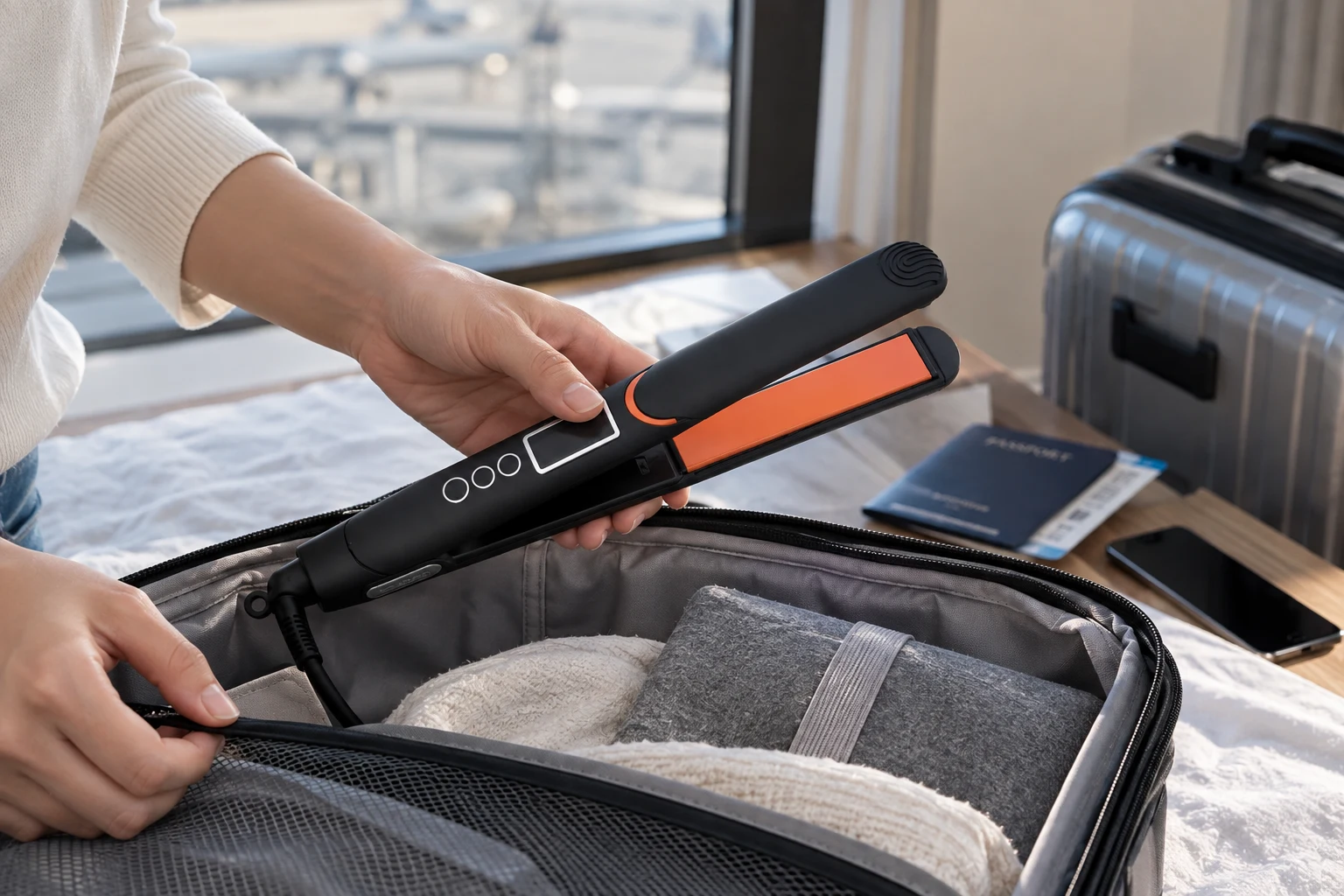
A travel flat iron should be defined by more than compact size. For importers, distributors, and private-label brands, the stronger buying criteria are electrical input, plug configuration, heat control, usable styling area, and the finished retail pack. Those factors determine whether the product can support a credible travel position and whether it fits the intended market, channel, and price tier.
In 2026, searches for travel hair straightener, dual voltage flat iron, and portable styling tools continue to overlap, but the commercial specifications behind those terms can differ significantly. For wholesale buyers, the key task is to define the travel use case first, then select a product configuration that supports it. Oucai’s hair straightener range gives buyers several starting points for product planning, while a travel-focused program should stay centered on destination-market requirements, portability, and retail positioning.
Travel Flat Iron Product Criteria for 2026 Wholesale Buyers
Before comparing features, purchasing teams need to decide what qualifies the SKU as a travel product in the first place. A smaller body can help, but it does not answer questions about electrical use, plug fit, temperature control, or the packed item. Defining these criteria early also reduces the chance of adding another straightener that looks different in the catalog but competes for exactly the same inventory position and customer.
Travel Flat Iron vs Standard Flat Iron
A standard flat iron is usually purchased for regular home or professional styling. A travel flat iron needs an additional role, such as easier storage, broader electrical input, or a more practical second-device option for trips.
For a B2B buyer, the first comparison should therefore be commercial, not cosmetic. Ask what problem the travel version solves that the existing straightener does not. If the answer is only “it looks smaller,” the SKU may need a stronger position before it is ready for wholesale rollout.
Why Mini Size Alone Does Not Define a Travel SKU
A travel size flat iron and a mini flat iron can overlap, but the terms should not be treated as identical.
“Mini” mainly describes physical scale. Travel positioning also brings in input voltage, plug configuration, heat adjustment, packed footprint, and practical styling use. Compact size supports the story only when the rest of the commercial configuration matches the intended market.
This distinction also creates useful search coverage around travel flat iron vs mini flat iron, without turning the article into another plate-size guide.
110–240V Input, Plug Configuration and International-Market Planning
Electrical configuration is one of the most important buying checkpoints for an international travel flat iron. It is also an area where retail shorthand can hide important details. Products are frequently searched as dual voltage flat irons, but a wholesale specification should state the actual voltage and frequency range. The physical plug then needs to be considered separately. Treating those as two RFQ fields makes market-version planning much clearer.
Voltage Input and Plug Type Are Separate RFQ Decisions
The U-9162 travel hair straightener available from Oucai operates on a 110–240V~50–60Hz power supply. That gives buyers a defined electrical basis for a travel-oriented project.
It does not mean one physical plug automatically fits every destination. Voltage range and plug shape solve different problems.
For buyers comparing products marketed as a dual voltage flat iron, the safer procurement approach is simple: verify the actual electrical specification first, then specify the target-market plug separately.
Confirm the Destination Market Version Before Sampling
The sample should represent the version that purchasing intends to sell.
Before approval, confirm the destination market, required electrical input, plug configuration, labeling direction, and manual requirements. This becomes especially important when a 110–240V hair straightener is being considered for several regions.
Otherwise, a sample can pass styling review while still needing commercial changes before production. That means more communication, another approval loop, and sometimes a second sample round. Better to settle the market version early.
Heat-Control Architecture and Travel-SKU Positioning
Once the electrical version is clear, heat control helps determine where the travel SKU sits in the product line. Some compact tools are intentionally basic. Others are positioned as travel-friendly products without giving up adjustable controls. Neither direction is automatically better. The buyer needs to match the control system to the target retail tier, channel, and customer expectation rather than adding features simply because they are available.
Adjustable Heat for a Full-Function Travel SKU
U-9162 combines an LCD display with 10 temperature levels, PTC heating, and a maximum temperature of 210°C.
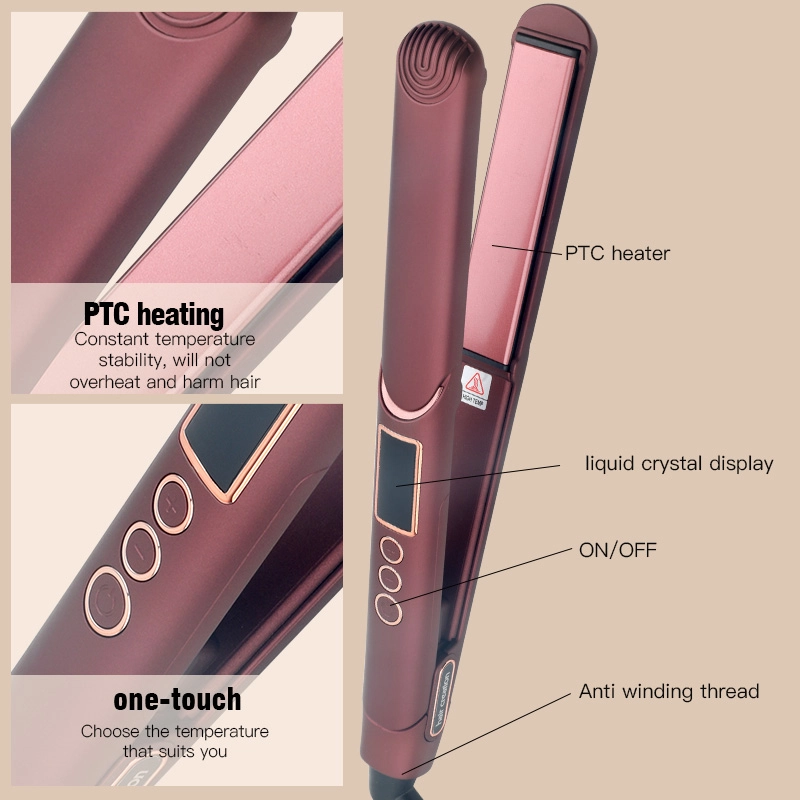
For procurement, the useful point is product positioning. Adjustable heat creates a different retail proposition from a basic single-setting travel iron. It can support a “travel-oriented but still full-function” direction without requiring the buyer to turn every feature into a marketing headline.
That is a much better basis for assortment planning than simply comparing maximum temperatures.
Heat-Control Repeatability in Sample Evaluation
Sample approval should go beyond switching the tool on and checking that it heats.
Run the controls through repeated cycles. Check display response, plate alignment, control consistency, and how the selected settings behave through repeated use. These checks give purchasing and QC a more practical reference for the approved configuration.
For a wholesale project, repeatability is usually more useful than chasing one headline specification. The goal is to approve a product behavior that can be clearly communicated and checked again later.
Balancing Styling Area and Packed Footprint for Travel SKUs
After electrical and heat-control choices are settled, the next question is whether the finished tool still supports the intended travel position. Portability creates a trade-off: reducing size can make packing easier, but the styling area still needs to feel usable. For a travel SKU, plate dimensions are therefore most useful when considered alongside the complete product and retail pack rather than treated as a stand-alone sizing decision.
Styling Area vs Packed Product Footprint
U-9162 uses a 24 × 105 mm ceramic plate.
For buyers, that dimension becomes a sample benchmark rather than a feature to repeat throughout the listing. The next step is to look at the finished item in its retail packaging.
A travel product is stored, displayed, shipped, and carried as a complete unit. Reviewing only the bare straightener misses part of the commercial picture.
Storage, Cord Management and Retail-Pack Efficiency
During sample review, check how the cord sits in the box, whether the unit can be repacked cleanly, and whether the retail pack remains proportionate to the product.
An unnecessarily large box can weaken the travel story and add shipping volume. At one sample, that may look minor. Across a wholesale order, it becomes a practical cost and merchandising issue.
The product and package should support the same positioning. They do not need to compete for attention.
Retail Positioning for Travel Flat Iron Wholesale
A travel straightener should have a defined job in the assortment before the discussion moves to order volume. This matters most for brands that already sell a conventional flat iron. The new model should add a different use case or channel opportunity instead of simply shifting demand from one existing SKU to another. Broader category trends can help provide context, but the travel decision should stay centered on portability, electrical planning, and retail role.
Channel Fit for E-Commerce, Beauty Retail and Travel Programs
For e-commerce, a portable hair straightener can be presented around its travel role, confirmed electrical range, heat-control format, and storage convenience. Physical beauty retail may need a simpler message that can be read quickly from the package.
Oucai’s Hair Straightener Trends 2026 guide covers the wider straightener category, while a travel SKU needs a narrower commercial brief.
The channel should help shape that brief. A marketplace listing, distributor catalog, and travel-focused retail program do not always need the same product story.
Define a Distinct Retail Role for the Travel SKU
A category manager should be able to answer one question in a sentence:
Why would a customer buy this model if the brand already offers a standard flat iron?
The answer might be trip use, easier storage, broader voltage input, or a second-tool position for a travel bag. The exact direction depends on the channel.
What matters is that the product configuration supports that promise. This is where travel flat iron wholesale planning becomes more than selecting a smaller housing from a supplier catalog.
OEM RFQ Inputs and Sample-Approval Criteria for Travel Hair Straighteners
Once the travel position is fixed, the RFQ becomes much more precise. A hair straightener manufacturer can work from a better brief when the buyer defines the target market, electrical version, retail role, and sample criteria from the start. The same approach helps a private label hair straightener project keep purchasing, product, packaging, and QC teams aligned around one commercial configuration.
Product and Market Data Required Before Quotation
A practical OEM hair straightener RFQ should cover:
- destination market;
- expected order quantity;
- required electrical input;
- target plug configuration;
- temperature-control direction;
- branding and retail-pack direction;
- key sample-approval points.
The goal is not to make the RFQ unnecessarily technical. It is to remove ambiguity before quotation and sampling.
Use a Defined Configuration as the Sample Benchmark
After the sample is approved, keep that commercial configuration as the reference for later checks.
Electrical version, plug, controls, plate alignment, heat behavior, cord arrangement, labeling, and packed presentation should all be reviewed against what was approved. That gives the buyer and supplier a much cleaner basis for bulk-production communication.
For a travel program, fewer assumptions usually mean fewer corrections later.
Conclusion
A strong travel flat iron program starts with a distinct retail role, then works through electrical input, plug configuration, heat control, styling area, packaging, and sample approval. Compact size can support the product story, but it should not be the only reason the SKU is called travel-ready.
For distributors and private-label brands, a clear destination and channel brief makes the sourcing process much more useful from the first quotation. Buyers preparing a travel hair straightener project can contact Oucai for an RFQ with the target market, quantity, product direction, and packaging requirements.
FAQ
Q1: What makes a flat iron suitable for international travel?
A: Buyers should check electrical input, plug configuration, temperature control, practical portability, packed size, and styling usability. Small dimensions alone do not define an international travel flat iron.
Q2: What is the difference between a travel flat iron and a mini flat iron?
A: A mini flat iron mainly describes physical size. A travel flat iron may also be planned around broader electrical input, destination-market requirements, packing convenience, and a defined travel-use position.
Q3: Does a 110–240V flat iron still need a plug adapter?
A: It may. A 110–240V range describes electrical input, while the physical plug still needs to fit the destination socket. Plug compatibility should be checked separately.
Q4: What should buyers test before ordering travel flat irons wholesale?
A: Buyers should review the exact electrical version, plug configuration, control response, heat repeatability, plate alignment, cord handling, labeling, and final packed product before bulk approval.
Q5: What should brands send a hair straightener manufacturer for a travel flat iron RFQ?
A: The RFQ should define the destination market, quantity, electrical input, plug requirement, temperature-control direction, branding needs, packaging direction, and sample-approval criteria.